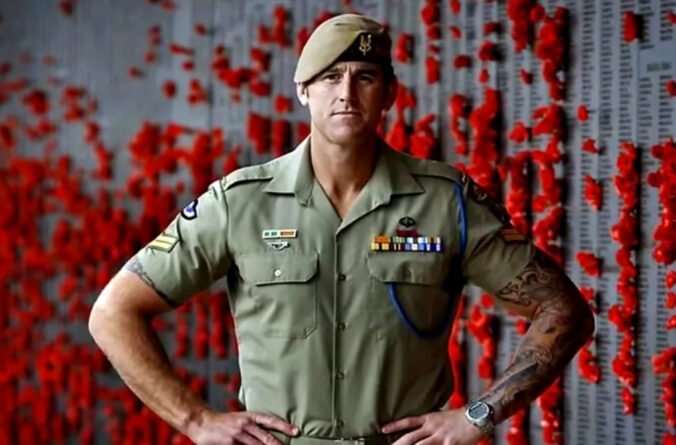
I was troubled to hear a few days ago of the arrest of Ben Roberts-Smith. Cpl Roberts-Smith is a war hero, a man of outstanding courage. That deserves respect. There was also the possibility that the case against him was biased from the beginning. It had not grown out of an army or police investigation, but out of “investigative journalism” a category of writing which is all too often agenda driven.
Having worked with emergency services personnel, and in the prison service, I have little time for armchair second-guessing of decisions that have to be made quickly and in dangerous circumstances.
In addition, the alleged crimes occurred some fifteen years ago. Statutes of limitations do not apply to murder or war crimes, but they are not technicalities. The further removed in time from the events, the more difficult it is to mount a comprehensive defense.
Exculpatory physical and forensic evidence may have been lost. Witnesses may have died or not be able to be found. Memories fade or change. Considerable care must be taken in any prosecution, increasingly so and with increasing doubt with every year that passes.
It is all very well to say “Let the law run its course,” but even the best-run courts can produce uncertain results. I have written published articles in a few such cases before, for example in relation to Archbishop Wilson of Adelaide, and Cardinal Pell. I had met both men and knew something of their careers, and the accusations seemed intrinsically unlikely. But feeling so, and having a fleeting familiarity with the accused is not enough. Coming to a conclusion that has any value means taking care to examine the evidence.
In the Wilson and Pell cases I examined court transcripts where available, along with witness statements, and conversed with people who were present in court. I became convinced that the claims against Archbishop Wilson were extremely unlikely, and the claims against Cardinal Pell verged on impossibility. In both those cases, early guilty verdicts were overturned by higher courts.
Let’s examine the evidence against Cpl Roberts-Smith.
Jurisdiction and legal basis:
• Roberts-Smith is charged with five counts of war crime murder involving the killing of unarmed Afghan detainees, which fall within Division 268 of the Criminal Code Act 1995 (Cth) (war crimes, crimes against humanity, genocide).
• The alleged killings occurred in Afghanistan between 2009 and 2012 while Roberts‑Smith was serving with the SAS in Uruzgan Province.
• Division 268 operates with extended geographical jurisdiction (via section 15.4 of the Criminal Code), allowing Australia to investigate and prosecute conduct by its nationals and service members overseas.
• The AFP and the Office of the Special Investigator have conducted investigations on the basis of this legislation. This is consistent with how Australia has chosen to implement its obligations under international humanitarian law.
There is clear statutory power for federal agencies to investigate and for the Commonwealth to prosecute alleged war‑crime murders committed by ADF personnel while serving overseas.
Gravity and specificity of the alleged offences:
• The indictment focuses on five specific alleged murders of unarmed detainees or civilians: incidents at Kakarak (two counts in April 2009), Darwan (one count in September 2012, involving Ali Jan), and Chinartu/Nachar (two counts in October 2012, including a joint enterprise killing).
• These are not broad or vague allegations. They are tied to particular dates, locations, operations, and victims, with detailed factual narratives able to be proved or disproved at trial.
This level of specificity, especially around dates, places and the status of victims (detainees, unarmed civilians), is necessary in order to justify a criminal trial for serious war‑crime charges.
Evidentiary foundation from prior proceedings:
• A 110‑day Federal Court defamation trial in 2021–2022 produced extensive evidence: 42 witnesses, including about 32 SAS soldiers (under pseudonyms) and three Afghan civilians giving evidence by video from Kabul.
• Evidence in this civil trial was not accepted uncritically. Justice Besanko rejected the evidence of person 100, noting either a lapse in memory or a deliberate cover-up, along with evidence of person 35, finding that that person and Cpl Roberts-Smith had fabricated a story designed to discredit another witness. Justice Besanko also considered the evidence of person 17, a former girlfriend, to be compromised and possibly untruthful. Her complaints and evidence form no part of the present case.
• In 2023, Justice Besanko found, on the civil balance of probabilities (applying the Briginshaw standard), that Roberts‑Smith murdered or was complicit in the murder of four Afghan men and engaged in bullying and other unlawful conduct.
• To clarify, in Briginshaw v Briginshaw (1938), the High Court held that the more serious an allegation, the stronger and more cogent the evidence needs to be before a court will be satisfied that the allegation is proved on the balance of probabilities. In the case of allegations serious criminal misconduct, such the allegations against Cpl Ben Roberts-Smith, the evidence needs to clear and decisive.
• On appeal, the Full Federal Court held in 2025 that this evidence was “sufficiently cogent” to support those findings. While not a criminal conviction, it confirms that a senior court has tested key witnesses and accepted that the core murder allegations have been proven to the standard required in a Civil case.
Witness evidence and corroboration:
• Multiple SAS eyewitnesses gave first‑hand accounts of the Kakarak, Darwan and Chinartu incidents, including the killing of a man with a prosthetic leg at Whiskey 108, the cliff incident with Ali Jan at Darwan, and an execution‑style killing at Chinartu allegedly directed by Roberts‑Smith.
• Afghan witnesses gave evidence about who was detained, who was unarmed, and how bodies were later found, particularly in Darwan. Their accounts were attacked in cross‑examination as being tainted by hostility to Australian troops. However they were consistent with accounts from Australian witnesses and were accepted as corroborative.
• Justice Besanko found that the key SAS and Afghan witnesses were generally credible: their evidence was internally consistent on central facts, corroborated by others and by mission records, and often given against strong unit‑loyalty pressures.
From the perspective of police and the Attorney-General this pattern; multiple independent eyewitnesses, corroboration by documents and physical circumstances, and prior judicial acceptance of their credibility, strongly supports further investigation leading to criminal charges and testing the evidence to the criminal standard.
Adverse credibility findings against Roberts‑Smith
• The Federal Court found that Roberts‑Smith was “not an honest and reliable witness”, identifying motives to lie (reputation, Victoria Cross status, financial interest in the lawsuit).
• The judge found deliberate lies about important collateral matters, including the fabricated story about a soldier being stood down after shooting a dog (collusion with Person 35), and false evidence about burying USB drives containing relevant material in his backyard.
• Besanko concluded that Roberts‑Smith was willing to shape and conceal evidence to protect himself, and that this undermined his denials regarding alleged unlawful killings.
In ordinary prosecutorial practice, such sustained adverse credibility findings in earlier litigation are a powerful factor indicating that a prosecution is not oppressive or speculative, but responds to a real risk that serious crimes were committed and then concealed.
Consistency with Australian and international practice:
• Australia has committed itself, in legislation and policy, to investigating and prosecuting alleged war crimes by its own forces rather than granting automatic impunity or relying solely on international courts. Division 268 of the Criminal Code is a central part of this framework. The credibility of Australia’s defence forces and justice system depends on its doing so wherever serious and substantiated allegations of serious are made, regardless of resistance or adverse public opinion.
• The Brereton Report into alleged SAS war crimes explicitly recommended criminal investigations, and the subsequent establishment of the Office of the Special Investigator and AFP war‑crimes teams is the practical implementation of those recommendations. While there are reasons to scrutinise the Brereton Inquiry’s processes, these mostly relate to interpretive weight and a perceived lack of adversarial protections and do not suggest its findings are incorrect or that it was compromised.
• Proceeding with charges where there is detailed incident‑based evidence, multiply corroborated witnesses, and prior civil findings of unlawful killings, is consistent with Australia’s obligations under the Geneva Conventions and with common practice in comparable countries.
Given this legal and policy environment, there is no reason to believe the decision to prosecute Roberts‑Smith is exceptional or politically driven; it is the expected response where credible evidence of war‑crime murder by an ADF member has been assembled.
To summarise, the prosecution in this case is justified because:
• There is clear statutory jurisdiction to prosecute war‑crime murder committed overseas by ADF personnel (Division 268 and extended geographical jurisdiction).
• The alleged conduct consists of serious, specific incidents involving unarmed detainees and civilians under Australian control.
• A long, adversarial civil trial has already produced detailed, corroborated evidence that a Federal Court judge and the Full Court have found sufficient to establish on the balance of probabilities that four murders took place.
• That same process produced systematic adverse credibility findings against Roberts‑Smith, including deliberative lies and evidence manipulation.
• Proceeding to a criminal trial aligns with Australia’s legal obligations and usual practice for alleged war crimes, and offers both the accused and alleged victims the procedural fairness of a determination to the higher criminal standard.
Sadly, being a war hero does not exclude the possibility of being a murderer. In this case, the prima facie evidence of serious wrongdoing is so strong that integrity of Australia’s justice system and armed forces depends on a full and open examination of the charges against Cpl Roberts-Smith.



Leave a Reply