There are two scientifically credible explanations for how the COVID-19 pandemic began (deliberate bioweapon creation is not one of them; there is zero evidence to support that claim, and no experts or credible politicians accept it):
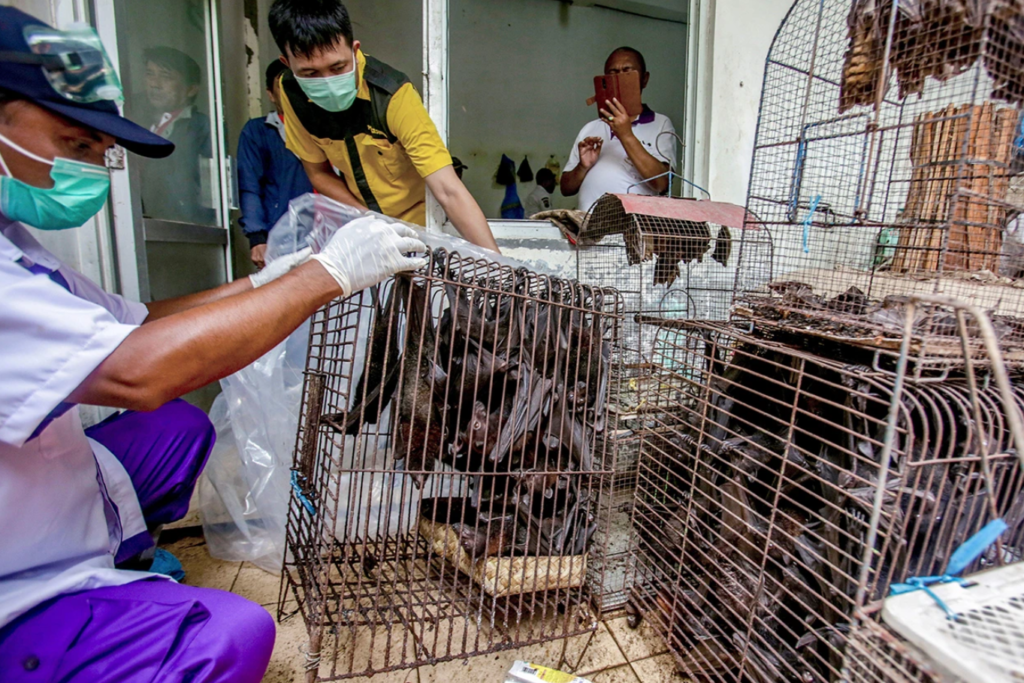
1 Zoonotic spillover. This means that the virus jumped from an animal host to humans, probably at or near the Huanan Seafood Wholesale Market in Wuhan.
2 Lab leak. This is the claim that the virus escaped from the Wuhan Institute of Virology (WIV), sometimes just called the Wuhan Lab.
Evidence favouring zoonotic spillover:
● Market-linked case clustering: The earliest known COVID-19 cases, including many with no direct link to the market, clustered tightly around the Huanan market, and environmental swabs from stalls known to sell live mammals susceptible to coronaviruses tested positive for the virus. Detailed spatial and genomic analyses supporting this were published by Worobey et al., Science (2022) and Pekar et al., Science (2022).
● Two early lineages at the market: genomic work indicates at least two distinct early SARS-CoV-2 lineages (A and B) were circulating, consistent with more than one spillover event from an infected animal pool rather than a single lab escape.
● Precedent: both SARS-CoV-1 (2002) and MERS emerged from animal reservoirs (civets and camels, respectively) via the wildlife trade, giving spillover a strong and recent prior history.
● Virological plausibility: coronaviruses closely related to SARS-CoV-2 circulate in bats across Southeast Asia, and serological studies show some regional human populations already carry antibodies to bat sarbecoviruses (the subset of coronaviruses that includes SARS and COVID-19), demonstrating that bat-to-human spillover is not unusual.
● Genomic features fit natural evolution: analyses have found no clear signature of genetic engineering, and none of the laboratory-adaptation markers (such as mouse-adaptation mutations) expected if the virus had been extensively passaged in cell culture before emerging.
● None of the viruses records indicate were under investigation at the Wuhan Lab could qualify as a predecessor to the early A and B variants of COVID-19.
● The 2025 WHO SAGO report: after roughly 3.5 years of work, the WHO’s Scientific Advisory Group for the Origins of Novel Pathogens (SAGO) concluded in its June 2025 report that the weight of available evidence points to zoonotic spillover, directly from bats or via an intermediate host but stopped short of ruling out a lab leak, noting China’s reluctance to hand over complete information. A summary by 23 of the panel’s members appeared in Nature.
Evidence favouring a lab leak:
● Geographic coincidence: the WIV, one of the world’s leading centres for bat coronavirus research (including gain-of-function-adjacent work), is located in the same city only a few miles from where the outbreak began.
● Illness among lab staff: reports that before the market cluster was recognised several WIV researchers experienced cold or flu like symptoms, which were later claimed to be possible evidence of COVID-19 infection.
● No confirmed intermediate host: despite extensive searching, no animal at the market or in the wildlife trade has been confirmed as infected with a direct SARS-CoV-2 ancestor virus. This is a gap some scientists argue is unusual if spillover were the source.
● The furin cleavage site: some virologists point out that the furin cleavage site in COVID-19’s spike protein is not seen in closely related bat coronaviruses. This requires further investigation. But furin cleavage occurs naturally in many coronaviruses and most virologists consider this unexceptional.
● Limited transparency: China has not released raw case data, WIV lab notebooks, biosafety records, or details of withdrawn viral-database entries. This is suspicious, and is an obstacle multiple investigators, including WHO’s own SAGO team, say has prevented a conclusive assessment either way.
Where does the preponderance of evidence lean?
There is no definitive, universally accepted proof for either hypothesis. Most virologists and epidemiologists who have studied the case data continue to lean toward zoonotic spillover, centred on the Huanan market, as the better-supported explanation, while a minority of scientists and several intelligence agencies consider a lab-related origin plausible or more likely. The WHO’s 2025 SAGO assessment explicitly kept the question open, noting that missing data from China was the main obstacle to a firm conclusion. The two positions have also become associated with different national and partisan narratives, which has made the scientific debate hard to separate from political issues..
References:
https://www.science.org/doi/10.1126/science.abp8715
https://www.science.org/doi/10.1126/science.abp8337
https://www.who.int/…/independent-assessment-of-the…



Leave a Reply