Qohel

Make a Difference

Page 18 of 110

Syria: A Christian Response

Part of a long and thoughtful article by Sohrab Ahmari, writing at Commentary Magazine.

” … the troubling outcome of the Iraq project doesn’t automatically vindicate the reflexive Christian opposition to today’s escalation in Syria. Christian supporters and critics of Trump’s move must apply public moral reasoning informed by the faith’s rich tradition of thinking about war and peace. The critics, I believe, have the weaker case—for two reasons.

First, Christians cannot remain ambivalent in the face of grave evil. This is true of the individual soul, who is called to wage spiritual combat against the evil within his heart (cf. Mt. 15:19), but it is also true of powers and nations. The Catechism of the Catholic Church is instructive on this point: “Actions deliberately contrary to the law of nations and to its universal principles are crimes” (2313; emphasis added). And more: “Every act of war directed to the indiscriminate destruction of whole cities or vast areas with their inhabitants is a crime against God and man” (2314).

It follows that Christians must support efforts to defang regimes that commit such crimes. According to the U.S. and numerous other Western intelligence agencies and civil-society organizations, the Assad regime is responsible for the vast majority of deaths in Syria’s civil war. It is the Assad regime that drops shrapnel-packed barrel bombs on densely packed civilian population centers. It is the Assad regime that runs industrial-scale torture facilities. And it is the butcher of Damascus who has used chlorine, sarin, and other chemical weapons against his own people, most recently in Eastern Ghouta.

Assad’s depravity goes far beyond cynical power politics and cruelty in wartime of which most nations through history have been guilty. Rather, Assad is racing for a place in the mass-murderer’s Hall of Infamy. Years from now, when the civil war is at last over and the West reckons with its failure to stop Assad’s killing machine in time to save half a million people and counting, it will not do for Christian opponents of military action to say: “But Iraq had gone so badly!” Or: “We couldn’t tell who was good and who evil in that fight!” Or: “Assad was fighting Islamists and protecting Syrian Christians!”

As Weigel wrote, “Whatever its psychological, spiritual, or intellectual origins, moral muteness in wartime is a form of moral judgment—a deficient and dangerous form of moral judgment.”

Second, Christians cannot remain ambivalent when the “minimum conditions of international order” are at stake. Christians, especially Catholic Christians, have spent two millennia thinking about world order. Through the ages, the Church and its greatest theological minds have constantly emphasized the need for a just, well-run, and peaceful order. As Weigel noted, however, the political peace that Christianity has in mind is not the permanent absence of conflict, a condition that is impossible to achieve so long as human life is disfigured by the mystery of evil—even after the Cross and the Resurrection.”


Syria: Sending a Message

How to send a message that use of chemical weapons crosses a red line, as then President Obama insisted (and then, appallingly, failed to act), without involving the US in another pointless ground war on the other side of the world?

This article by Thomas Lifson on American Thinker makes the case that President Trump got this right. Let’s hope no further messages are needed.

“As the war drums were being beaten for an attack on Syria in response to its apparent use of chlorine gas, I shared some of the fears of such critics as Tucker Carlson and Michael Savage – that we were being led into a possible war that could end up a quagmire.  My greatest reservation was the possibility of toppling Assad and reaping another Libya or Iraq, with even worse enemies taking control.  And for all the brutality of the Assad regime, it has prevented wholesale religious massacres in a multi-religion state.

But so far, the strike on three targets in Syria appears to have been not too much, not too little, but just right to deliver the necessary message.”

Read the rest:

https://www.americanthinker.com/blog/2018/04/a_goldilocks_air_strike_on_syria.html#ixzz5ChP4C1NY


Green Power, Black Death

Paul Driessen pointed out years ago that green policies mean stopping developing nations from developing by depriving them of energy and clean water.

Viv Forbes lists the ways green policies also undermine the continuing growth of the West. Greens are not only traitors to the poor, they are traitors to the environment:

Greens hate individual freedom and private property. They dream of a centralised unelected global government, financed by taxes on developed nations and controlled by all the tentacles of the UN.

No longer is real pollution of our environment the main Green concern. The key slogan of the Green religion is “sustainable development”, with them defining what is sustainable.

Greens hate miners. They use nationalised parks, heritage areas, flora/fauna reserves, green bans, locked gates and land rights (for some) to close as much land as possible to explorers and miners – apparently resources should be locked away for some lucky distant future generation. And if some persistent explorer manages to prove a mineral deposit, greens will then strangle it in the approvals process using “death by delay”.

Greens hate farmers with their ploughs, fertilisers, crops and grazing animals. They want Aussie grazing land turned back to kangaroos and woody weeds. They plan to expel farmers and graziers from most land areas, with food produced in concentrated feedlots, factory farms, communal gardens and hydroponics.

Greens hate professional fishermen with their nets, lines and harpoons. Using the Great Barrier Reef as their poster-child, they plan to control the Coral Sea using marine parks, fishing quotas, bans and licences, leaving us to get seafood from foreign seas and factory fish farms.

Greens hate foresters and grass-farmers. They want every tree protected, even woody weeds taking over ancient treeless grasslands. Red meat and forest timber are “unsustainable”. Apparently they want us to live in houses made of recycled cardboard and plastic and eating fake steak and protein powder made from methane generated from decomposing rubbish dumps.

Greens despise the suburbs with their SUV’s, lawns, pools, rose gardens, manicured parks, ponies and golf courses. They prefer concentrated accommodation with people stacked-and-packed in high-rise cubic apartments, with state-controlled kindies in the basement, and with ring-roads of electric trams and driverless cars connecting apartments, schools, offices and shops.

Greens hate reliable grid power from coal, nuclear, oil, gas or hydro generators. Their “sustainable” option is part-time power from wind and solar with the inevitable blackouts and shortages needing more rules and rationing.

Greens lead the war on fracking and pipelines. The victims are energy consumers. The beneficiaries are Russian gas and Middle-east oil.

Greens think it is “sustainable” to uglify scenic hills with whining wind towers, power poles, transmission lines and access roads, and to clutter pleasant estuaries and shallow seas with more bird-slicing turbines. They think it is “sustainable” to keep smothering sunny flatlands under solar panels and filling the suburbs with extra power lines and batteries of toxic metals.

Greens think it is “sustainable” to clear forests for bio-mass to feed large wood-fired power stations, or for establishing biofuel plantations. They think it is “sustainable” to keep converting croplands from producing food for humans to producing ethanol for cars.

Greens hate free markets where prices are used to signal changing supply and demand. There is no room for fun, frills or luxuries in their “sustainable” world. They want to limit demand by imposing rationing on us wastrels – carbon ration cards, electricity rationing meters, water rationing, meat free days, diet cops and bans on fast foods and fizzy-drinks.

They also favour compulsory recycling of everything, no matter what that process costs in energy or resources. Surveillance cameras will keep watch on our “wasteful” habits.

None of this vast green religious agenda is compatible with individual freedom, constitutional rights or private property – and none of it makes any economic or climate sense.

Renewable Energy?

So called renewable energy is not renewable.

When you take into account the cost of construction, installation, maintenance, transmission, and the need to keep real energy sources running constantly to make up for fluctuations in supply caused by the unreliability of wind and sunlight, any wind or solar installation has a net cost in energy. No real contribution at all. Zero. Except to make governments and activist groups feel good about themselves. This is why, once the subsidies stop, wind and solar installations cease to function, and rust into the ground. The little they produce is not even enough to cover the cost of maintaining them.

Wind turbines produce less than one percent of the world’s energy, solar panels even less.

The cost of energy to consumers has to increase to cover the massive expense of these vanity projects. The more “renewable” energy in the mix, the higher the retail cost of electricity.

They are expensive and produce no net gain. Time to call it quits. Just stop taking tax-payer money to prop them up, and they will go away. And then private enterprise will have an incentive to invest in infrastructure that really works, and in researching new and efficient forms of energy production and distribution.

“Renewable energy” puts a brake on development in the West, and keeps millions of people in developing nations powerless and in abject poverty. Climate justice is exactly the opposite of justice.

Nothing Left to Ban

Since the UK banned most personal ownership of firearms, its rate of knife crime has risen to the point where someone in Britain is attacked with a knife every four minutes. In addition, London now has one of the highest rates of acid attacks in the world. No mention in the Independent of the likely cause of this massive increase in recent years, of course.

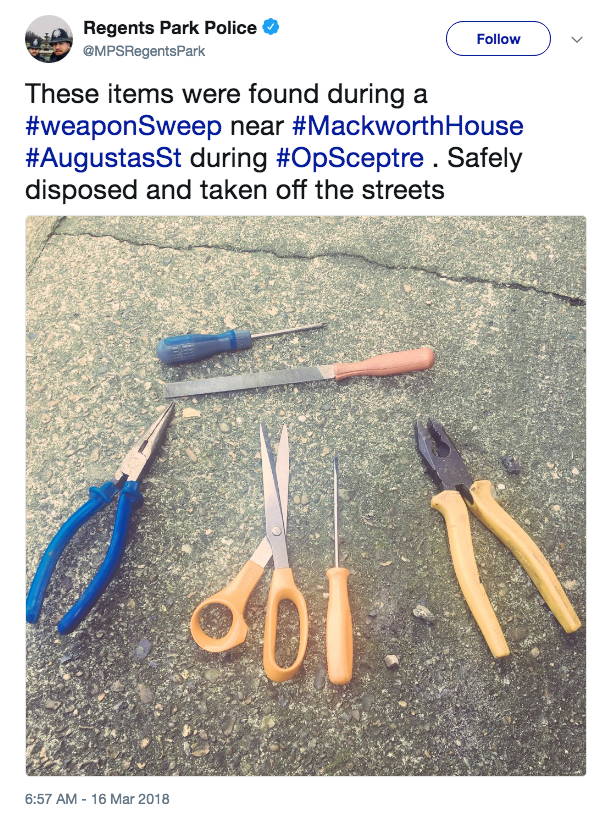
A couple of days ago, Regents Park (London) police reported with pride that they had conducted a street search and removed and disposed of the following dangerous items.

Seriously? These are all normal, useful items found in almost every home. On any given day I would be likely to have two or three of them in my pockets, as well as my Leatherman multi-purpose tool which includes a knife and several other potentially dangerous tools.

Removing tools, including knives and guns and corrosive liquids, from everyone because someone might use them to harm someone else does not reduce crime. Some other object can always be found. Focusing on the object used in the crime is senseless.

Strange Days at the Commonwealth Games

Besides two blokes winning medals in the Women’s 800 metres (they couldn’t be excluded because like, equality) there are a few other noteworthy results from the Commonwealth Games this year.

The host nation, Australia, has twice as many as many medals as any other country, including England, Canada and the massively more populous India. And little New Zealand, with a population of four million, has twice as many medals as Nigeria, which has a population of 198 million.

I was born in New Zealand and live in Australia. I don’t know know whether I should be proud or embarrassed.

Not Compassion but Envy

Inequality is often cited as a major cause of social disruption, and an urgent justice issue for democratic societies.

It has been pointed out many times before that you can have freedom, or you can have equality. You can’t have both, for the simple reason that different people will make different choices. That is what freedom means – the ability to make choices. And if people choose to use their time and their resources differently, the outcomes will be different.

For conservatives and libertarians that’s fine. Choose what you want, and take responsibility for your choices.

But for some of the have nots, even if their having less is a direct consequence of their choices, this seems horribly unfair. It has become unsurprising to hear younger people complain that they do not have as much “stuff” as older people. But older people started with even less than today’s younger people do. They worked, and saved, and paid their mortgages, and saved again for new furniture, and built up assets and capital over a lifetime. So it ought to be unsurprising they have more. They have worked for what they have, and made sacrifices along the way, of time as well as of other things they might have liked – a faster car, holidays, computers, etc.

To conservatives, the answer to be given to the have nots seems obvious. Make choices, work for them, and don’t complain that because you spent ten years travelling, you are ten years behind in saving for a house.

At its base, complaining is envy. It is not compassion, or a desire for justice. If it were, the complainers would be at the forefront of volunteering to help others, and of giving to help others. Instead, it is conservatives who are more personally generous by a large margin, and who are more likely to volunteer as firefighters or ambulance officers or in other ways in their own communities.

Demands for change made by progressives are not driven by love for the poor, but by resentment of anyone who has more.

https://youtu.be/wreDa1xarTM

What “Gun Free Zone” Really Means

In other words, criminals feel free. No one here can stop you. And exactly why the Orlando shooter decided not to attack families at Disney World, his original target, and went for the much softer option of a gun-free gay nightclub. The guards at Disney World were scary.

Moringa – the Latest Superfood Supplement Scam

“Dried moringa leaves are a storehouse of concentrated nutrition, so even a small daily dose can help correct imbalances in the body, add concentrated nutrition to your diet and help you reach the recommended daily dietary targets of fruits and vegetables.”

This claim was made by an Indian company; Organic India Private Limited. In 2015 the Advertising Standards Council of India (ASCI) upheld a complaint against the company for this advertisement, finding its claims were unsubtantiated.

If it were just a matter of comfortably-off people buying supplements that don’t contain anything useful, and wouldn’t help most people even they did (the only time a dietary supplement is helpful is if you are deficient in some particular nutrient, in which case you should seek advice from a medical doctor), then it wouldn’t matter too much. People will always find silly things to spend money on, and it is no one’s business but their own.

That does not excuse the sellers of these products, who generally know that what they are selling is useless. Even if they do not have the skills to analyse the claims made by the parent company, the methods employed should be a dead giveaway. For example, in the case of one multi-level marketing Moringa company, agents are given scripts which they are told to claim as their own stories, to share with potential clients and on social media. They generally go like this:

I was feeling x (fat, ugly, tired, sleepless, lacking energy, etc). Nothing else worked, so I decided to try y (the moringa product). I was sceptical, but after two weeks, the difference was amazing. I was z (slimmer, more energetic, sleeping better, dating Brad Pitt, etc, etc). The next time I went to the doctor, he/she was amazed. I told him/her about y, and showed him/her the list of nutrients it contains. He/she was so impressed he/she asked where he/she could get some for him/her self.

Any company that suggests it is appropriate to tell invented histories, ie lies, to family, friends, and customers, is not a company whose claims you should be taking at face value. That is bad enough.

But when extravagant claims are made for weight loss, or for cures for cancer or diabetes or other acute or chronic illnesses, then selling such products crosses a line from being merely unethical to being illegal. Or even where not illegal, monstrous. It is wrong to take advantage of people who are poor, who are ill, who are desperate.

You would hope people would be well aware by now that every few years some new miracle supplement, superfood, or therapy appears, promising weight loss, new youth, and social success. Bai-lin Tea, Cal-Ban, Herbalife, are all earlier examples. But sadly not.

Moringa is just the latest in a long line of supplement scams.

Don’t fall for these scams. Don’t buy these products.

The Murray River and Pudding-headed Pixies

I am getting a little tired of seeing people repost Jeremy Buckingham’s moronic video about Cubbie Station and the Murray/Darling  basin.

It’s always the end of the world with these loons. Everything is going wrong, everything’s a disaster, the world is going to end. Unless you vote for us, give us lots of money, and return to the stone age.

Buckingham, by the way, is the same tax-teat-tippling twit who told us that thousands of year old naturally occurring swamp gas was proof of the horrors of fracking.

Buckingham claims Cubbie Station diverts the water from the Balonne/Culgoa catchment before it can reach the Darling and flow downwards into the Murray. They are stealing water from the environment and from other Australian farmers!!!

They are not. In fact, Cubbie Station is an almost perfect example of sustainable water use in arid areas which are also prone to flooding – like much of the Australian outback. It is the kind of development the pudding-headed pixies in the Australian Greens would be supporting whole-heartedly and encouraging others to use as a model, if they actually cared about Australian workers or the environment. They don’t.

I have lived on the Balonne River, which is what the Condamine is called as it starts to move down toward the Darling. And I have lived at Murray Bridge. That doesn’t make me an expert. But it does mean I have some idea of issues at both the upper and lower reaches of the Murray-Darling. And I have visited Cubbie Station.

Cubbie Station is a miracle of engineering, common-sense and foresight. It has massive water storage capacity: just over 500 megalitres. And it has large and efficient recycling systems.

Essentially it relies on the rain-bearing storms which occur every ten years or so. Cubbie acts as a flood mitigation system. It catches water from those ten year floods which would otherwise cause damage downstream and then be lost to evaporation. Because it takes flood water which would otherwise be lost, Cubbie is able to take just over one quarter of one percent of the Murray’s total flow, but without affecting at all the useful environmental flow, or the amount of water available to recreational or agricultural users. In addition, Cubbie filters and recycles constantly to maximise water use and minimise loss. When water can no longer be recycled, it is sequestered so that not a drop of fertiliser or pesticide flows into river catchment.

As I said, it is exactly the kind of carefully planned, carefully managed system which greenies should be having parties to celebrate if they cared about Australian land, industry, workers or environment.

Did I mention that Cubbie is managed by an Australian company with an Australian workforce, has revitalised the town of Dirranbandi, is the town’s major employer, and generates about $100 million in export revenue every year?

Rules for Apostrophes

Rules for apostrophes!

There are only a few, and they are simple.

Rule 1. If the word is simply a plural, it does not need an apostrophe. Ever. For example, the plural of CD is CDs, not CD’s. The plural of DVD is DVDs, not DVD’s. The plural of seafood is seafoods, not seafood’s. The plural of tomato is tomatoes, not tomato’s.

That is the first rule. No apostrophes for plurals!


Apostrophes are used to tell the reader one of two things; ownership (sometimes called possession) and contraction. Let’s look at ownership first. This is rule two.

Rule 2. If a dog has a bone, then it is the dog’s bone. If a boy has a football, it is the boy’s football. If a girl has ten tractors, they are the girl’s tractors.

But what if there is more than one girl? Then they would be the girls’ tractors (with the apostrophe after the ‘s’). If there was more than one boy, it would be the boys’ football.

When more than one person owns something, the apostrophe comes after the ‘s’ at the end of the word. The ‘s’ in those words is just the normal plural (more than one) ‘s’. The apostrophe comes after the ‘s’ to show there is more than one owner.

So that is rule number two, and it is also easy. If you read “The boy’s toy,” that tells you there is one boy who owns one toy. If you read “The boy’s toys,” there is one boy who owns lots of toys. If you read “The boys’ toys,” (with the apostrophe after the ‘s’ in boys) there are lots of boys who own lots of toys.

English is a wonderfully precise language. Apostrophes are one of the tools that help us to express what we mean with a clarity that is often not possible in other languages.

Rule 3. Apostrophes show where missing letters should be. Sometimes we put two words together to make one word, and then take some letters out to make the new word shorter. An apostrophe shows where the missing letter or letters used to be. For example, can not becomes can’t. I am becomes I’m. Do not becomes don’t. I would becomes I’d.

This is also a very straightforward rule. If you put two words together to make one word, and take a letter or letters out to make the new word shorter, you use an apostrophe to show where the missing letters were.

There are a few contractions that don’t make a lot of sense. For example, “Will not” becomes “Won’t.” You just have to learn these as you come across them. But there aren’t very many, so they are nothing to worry about.

There is only one other thing to remember, and that is distinguishing between its and it’s. We can call this rule four.

Rule 4. “It’s” (with an apostrophe) always means “It is.” Always. If you are tempted to write “it’s,” ask yourself “Do I mean ‘It is’?”

I’ll say that again. “It’s” always means “It is.”

“Its” (without an apostrophe) is a possessive pronoun, like his, yours, mine. It shows ownership. When you talk about an “it” owning something, for example, “The dog ate its bone,” you do not need an apostrophe. If you did put an apostrophe in that sentence “The dog ate it’s bone,” you would be saying “The dog ate it is bone,” which doesn’t make any sense. “It’s” always means “It is.” Always.

So that is easy too. “Its” (without an apostrophe) means that “it” owns whatever comes after; “Its bone,” “Its blanket.”

“It’s” (with an apostrophe) means “It is.”

So there you are. Six hundred words, and you know everything you will ever need to know about apostrophes!

Mass Murders and Gun Control

Every time there is a major public shooting in the US, there is an outcry on Twitter and Facebook; It’s so easy! Can’t they see what the problem is? Just take the guns away! Don’t they care about their children? And then the laments; nothing will change. They don’t care. They are only worried about votes.

The reason nothing changes as a result of these Facebook tirades is that they consist of little but slogans. They don’t address the real problems, and consequently, offer no real solutions.

Take, for example, the claim there have been eighteen school shootings in the US this year. Even the Washington Post, no friend to Trump or the Republicans, has examined this claim and found it to be false. The group that compiles these figures uses as its definition of a school shooting “Any time a firearm discharges a live round inside a school building or on a school campus or grounds.” This has included, for example, when a man unrelated to the school committed suicide in his car hours after the school closed and the carpark was otherwise empty, or when a group of university students were at a meeting of a criminal justice club in Texas and a student accidentally fired a real gun rather than a training weapon. No one was injured. Or when a police officer’s gun accidentally discharged in a high-school carpark, again, injuring no one. In reality, eleven schools in the US since Columbine in 1999 have experienced mass shootings involving student fatalities.

Eleven mass shootings in schools in eighteen years is a horrendous figure. It indicates a problem that needs to be addressed. It does not need to be exaggerated.

Sadly, media reports seem to delight in sending the message that the US is a dangerous and unpredictable place to visit. Again, this is untrue. The US is not in the top ten countries in the world for gun related deaths, not counting active conflict zones. The US sits between eleventh and eighteenth, depending on whose figures you consider reliable. But this does not take into account that two thirds of firearm related deaths in the US are suicides. This figure is certainly a by-product of the easy availability of guns in the US, and of the quickness and deadliness of guns compared with other methods.

Of genuine gun murder victims, sixty percent are black males between the ages of fifteen and thirty-five. Black males in that age group also commit nearly fifty percent of all gun related murders, despite making up only about five percent of the population. Most fatal gun violence occurs in specific areas, and in specific racial groups. If you stay out of those areas; anywhere that has a long history of Democrat control, anywhere that has a high proportion of blacks or of illegal immigrants (I know you are not supposed to say these things, but they are true nonetheless) you are safer in the US than almost anywhere else in the world.

Mass shootings, though they are terrifying, in part because they are apparently random and feature loudly in headlines and news reports, account for only approximately one percent of all gun related murders.

Nor is the gun debate in the US a Democrat vs Republican conflict. At any time when Barack Obama was president and the Democrats controlled both the US Senate and Congress, they could have introduced stricter gun control measures. They did not. Incidentally, ninety percent of recent mass shootings in the US have been perpetrated by Democrat voters, including the most recent school shooting.

Is stricter gun control the answer? It is not clear that it is. One of the few safer places in the world than the US is Switzerland. More than thirty percent of adult Swiss own a gun, a rate higher than the US (statistics showing much higher rates of gun ownership in the US are based on the number of weapons vs the population, but this ignores the fact that many US gun owners own multiple guns) and yet at 0.6 per 100.000, Switzerland has one of the lowest rates of gun related homicide. In addition, some parts of the US where it is difficult to buy a gun legally also have the highest rates of gun related homicide, while some states and cities where open carry is permitted have amongst the lowest rates.

Are gun-free zones the answer? Definitely not! Ninety-six percent of recent mass shootings have taken place in areas in which guns were banned. Designating an area as a gun-free zone, whether a school, a club or a public event, does nothing except advertise to potential murderers that they will have anywhere from five to fifteen minutes of uninterrupted killing before anyone arrives who has the capacity to stop them.

Are the latest mass shootings President Trump’s fault? It is hard to see how when there has been no increase in gun related deaths including mass shootings during his term, and such a high proportion of gun deaths are perpetrated by Democrat voters and in Democrat controlled cities. It is true he and Congress declined to enact a regulation proposed by President Obama which restricted gun ownership for anyone receiving a government benefit who had been treated for a mental illness. This regulation was resisted strongly by the ACLU (no friend to the Republicans) and by mental health advocates.

One fifth of the population will receive treatment for mental illness during their lifetime, and despite Facebook posts to the contrary, and media and police reports claiming almost every example of Islamist violence as evidence of mental illness (a gross injustice to the genuinely mentally ill, just as describing muslim rape gangs as Asian rape gangs is a gross injustice to Asians) there is no correlation between receiving treatment for mental illness and an increased likeliness of committing violent gun crime. So no, recent mass shootings cannot be blamed on President Trump.

Another claim that is sometimes made is that Australia has solved the problem of mass shootings by a massive buy-back of weapons, and imposing restrictions on what weapons can be privately owned.  In reality, Australia had so few mass shootings before those controls were introduced that it is impossible to draw any valid conclusions about their impact on the rate of mass shootings, while the rate of gun ownership has now increased to pre-buyback levels, and the rate of violent crime overall has not changed. In other words, Australia cannot be used as an example, and even if it were, it would not be a very good one.

In addition, it is clear that if access to guns is made more difficult, those determined to commit mass murder will still find ways to do so, for example using improvised explosive devices or vehicles, sometimes with devastating results, as has been seen in the last year in the US, Europe and Australia.

Let’s review.

Increased gun ownership leads to an increase in completed suicides. Increased gun ownership in itself does not seem to lead to a higher rate of violent crime or murder. Those are much better correlated with drug abuse, gang membership, illegal immigration and some racial and religious groups. There is no realistic prospect of enacting legislation which restricts gun ownership in those areas or to those groups, or even of having a sensible discussion which takes those factors into account. Does that mean nothing can be done? No.

The largest group of firearm related deaths are suicides. A person determined to commit suicide will find a way to do so, but removing or even delaying access to guns will help to prevent impulses to suicide becoming completed suicides. People seeking treatment for depression or presenting as depressed should be asked if they have firearms at home, advised of the risk, and asked to consider other arrangements for safe-keeping. If acceptable to the patient, options should be discussed with family or close friends who should also be made aware of the risk to the patient of easy access to a firearm.

The second largest group of gun deaths and by far the largest group of murders are young black males in urban areas. Most of these deaths are related to drug use or gang conflicts, or incidental to the commission of petty crimes. Many of the areas in which these deaths occur already have strict gun controls in place. It is not clear that more laws is the answer. Instead, communities in which there is a high level of crime and violence need to take responsibility to reduce the level of crime and violence amongst their members, and to encourage positive relationships with law enforcement. Existing laws relating to drug use, gang membership and firearm ownership need to be enforced, with no excuses about no-go areas or about ethnic or gang violence being of less concern than other forms of crime.

Mass shootings and mass murders of any kind are extremely difficult to predict. But there are levels at which any community or group can be prepared. As a first step, put an end to the madness of gun-free zones. Nothing could be a more effective advertisement that a location or event is a soft and easy target.

Armed guards should be present any school at which parents and community agree that this is desirable. We take for granted that politicians and celebrities should have armed protection, and we are used to armed guards at banks and jewellery stores. Are children less deserving of protection? It is simply silly to say we should not have to do this. Of course we shouldn’t, but that is naïve and irrelevant. We do have to, just as we have to lock our doors and watch out for shop lifters and not leave our phones lying around. Having an armed and trained person on site means a response to violence or threats of violence in seconds rather than minutes. More importantly, it is a powerful disincentive. Either way, it saves lives.

There is one way in which a change to gun regulations would help. The recent school shooting was committed by someone about whom law enforcement had had more than one credible warning, and yet he was able to acquire a semi-automatic sports rifle capable of firing a two rounds every three seconds. That is simply absurd. People who have made threats about committing mass violence should not be permitted to acquire weapons legally. They will still be able to acquire them illegally, and they will still be able to plan and carry out murders using other means – vehicles, for example, or easily made aerosol poisons such as ricin, or IEDs. But difficulties in obtaining weapons legally may at least slow them down, and give law enforcement more time to track and apprehend them.

Gun control will reduce the number of peaceful, law abiding people who own weapons. There is no evidence it will stop mass murders or gangland violence. You cannot stop evil people planning and doing evil things. You can make it more difficult for them by restricting legal access to weapons for people with criminal records or who have made threats of violence, you can respond more quickly and more effectively, and you can ensure punishments are severe enough to act as a deterrent. These are the strategies that reduce the number of gun deaths.

Love isn’t Love, and “Gay Marriage” Isn’t Marriage

A couple of days ago I posted an article essentially saying that same sex relationships may be as loving and worthy of respect as heterosexual relationships, but they are a different thing, with different meaning to society, so it is wrong to get the government to force everyone to pretend they are the same.

Of all the odd responses I got, which included various names and obscene suggestions, this was surely the oddest: “How are they different? Give me one way they are different, you ignorant bigotted piece of sh%t.” I had three different variations of this question, including “Your an ar^$hole how th f$%k are they differnt?”

It surely cannot be the case that large numbers of people really cannot see any difference between a long term relationship between a man and woman which is open to the possibility of new life, and a relationship between two men or two women.

There are multiple differences. But the most fundamental is this: society can survive perfectly well without homosexual relationships. No society can survive without heterosexual relationships. This is why every society in every place and every part of history has given special recognition and protection to long-term heterosexual relationships. That is what marriage is.

To paraphrase gay activist Milo Yiannopoulos: ” I am in love. I would like that relationship to be recognised and celebrated. But It’s not a marriage. We all know it’s not a marriage. It is silly to pretend it is. Just call it something else.”

To be fair, people do and say silly things all the time. They don’t much matter. If some same sex couples want to go through a ceremony and say they are married, fine. I don’t want to stop anyone doing what makes them happy. But I do object to anyone trying to get the government to force everyone to pretend to agree, or labelling any disagreement “hate speech.”

Last word from gay Irish journalist Richard Waghorne:

“Marriage is vital as a framework within which children can be brought up by a man and woman.

Not all marriages, of course, involve child-raising. And there are also, for that matter, same-sex couples already raising children. But the reality is that marriages tend towards child-raising and same-sex partnerships do not. I am conscious of this when considering my own circle of friends, quite a few of whom have recently married or will soon do so in the future. Many, if not most or all of them, will raise children. If, however, I or gay friends form civil partnerships, those are much more unlikely to involve raising children.

So the question that matters is this: Why should a gay relationship be treated the same way as a marriage, despite this fundamental difference? A wealth of research demonstrates the marriage of a man and a woman provides children with the best life outcomes, that children raised in marriages that stay together do best across a whole range of measures. This is certainly not to cast aspersions on other families, but it does underscore the importance of marriage as an institution.

This is why the demand for gay marriage goes doubly wrong. It is not a demand for marriage to be extended to gay people – it is a demand for marriage to be redefined. The understanding of marriage as an institution that exists and is supported for the sake of strong families changes to an understanding of marriage as merely the end-point of romance.

If gay couples are considered equally eligible for marriage, even though gay relationships do not tend towards child-raising and cannot by definition give a child a mother and a father, the crucial under-standing of what marriage is actually mainly for has been discarded. What that amounts to is the kind of marriage that puts adults before children. That, in my opinion, is ultimately selfish, and far too high a price to pay simply for the token gesture of treating opposite-sex relationships and same-sex relationships identically. And it is a token gesture.

Isn’t it common sense, after all, to treat different situations differently? To put it personally, I do not feel in the least bit discriminated against by the fact that I cannot marry someone of the same sex.”

Credit for some of the above, including the long quote from Richard Waghorne, to Bill Muehlenberg’s thoughtful, detailed and meticulously researched book “Strained Relations.”

« Older posts Newer posts »

© 2026 Qohel