Make a Difference

Year: 2011 (Page 17 of 17)

Grasp Your Flotation Device Firmly!

This is one of those ‘only in Australia’ stories.

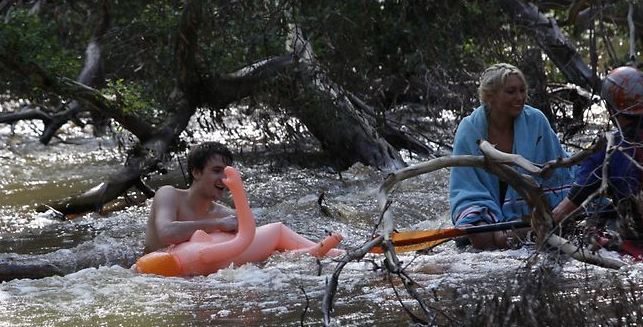
A young couple grabbed two inflatable women they had lying around the house and took them for a ride down the flooded Yarra River in Victoria.

The man and woman, both 19, were left clinging to a fallen gum tree in the middle of the river in North Warrandyte when one of the dolls snagged on the tree and their caper went horribly wrong about 4.30pm.

An SES watercraft came to their rescue not far from Bradleys Lane about an hour later.

While it is understood the blow up doll and several other inflatable items were salvaged from the scene, the bottoms of the rescued woman’s bathers were long gone down the river.

A blanket was required to protect her modesty as she exited the water.

Modesty Protected

Victorian Police issued a stern warning that inflatable women are not approved flotation devices.

Better Schools

One of my close friends is a teacher with many years of classroom and administrative experience.

She came to KICE (Kangaroo Island Community Education) with a long history of developing positive relationships with parents, writing and implementing thoughtful and interesting programmes, and helping her students to achieve high academic standards.

She is one of those rare teachers who knows what standards are, and cares enough about her students to make them work to achieve them.

She has frequently faced hostility from both students and parents, hostility which has been replaced by respect and gratitude when students realise that they can do the work, and parents see that their children are getting results which they would not have thought possible.

At KICE she faced hostility from staff as well. On more than one occasion I overheard other teachers sniggering about what was being done to her. All the most difficult students put in her classes. Denied acccess to resources and to her own office space. Openly undermined with parents and students.

I was so disturbed by this that I wrote to the Head of Campus at Kingscote. I didn’t even get a reply.

Meanwhile, bullying is rife, academic standards continue to be appallingly low, and the school cannot stay within its budget.

It was reported to me by a parent that at the end of year assembly one of the finishing students had thanked the staff for their support. So far so good. But the student reserved special thanks for a staff member who had regularly rung them to remind them they should be at school, and who had finished their work for them if they were feeling stressed.

I was astonished. Surely that person could not really have thought this was kindness? Or that she was doing the students any good in the long term?

My impression is that (in many state schools, anyway) teachers who know what children should be learning, and try to teach, and maintain objective standards and mark to them (in other words, who do the things that are proven to build confident and capable students), are finding themselves more and more isolated.

This article by Katharine Birbalsingh tells of her similar experiences on the other side of the world.

A couple of excerpts:

For years, I soldiered on in the classroom, working hard to change the minds of children who were paralysed by a sense of victimhood. They found it impossible to believe that I had chosen to be their teacher, that I wanted to be there, that I loved being around them. Eventually, like any good teacher, I won them over by using all the tricks of the trade, from gold stars to phone calls at home with positive comments, to holding breakfast clubs in the early morning when I would spend my own money on croissants. My students felt grateful. Like me, other teachers give their life to the job, and we “succeed” despite of the shackles of the system.

The regular dumbing-down of our examination system is obvious to any teacher who is paying attention and who has been in the game for some time. The refusal to allow children to fail at anything is endemic in a school culture that always looks after self-esteem and misses the crucial point, which is that children’s self-esteem depends on achieving real success. If we never encourage them to challenge themselves by risking failure, self-esteem will never come …

I had become indoctrinated by all the trendy nonsense dictating that if children are not behaving in your classroom, it is because you have been standing in front of them for more than five minutes trying to teach them. If only you had sat them in groups with you as facilitator, rather than teacher at the front, then you’d have the safe environment conducive to learning that we all seek. The basic ideology is that if there is chaos in the classroom, it is the teacher’s fault. Children are not responsible for themselves, while senior management fails to establish systems that support teachers and punish children for not doing their homework, whatever their home situation.

I argued constantly with my colleagues and bosses. Often, I won and, almost as if they were inextricably linked, as the innate liberalism within people waned, the department or the school would improve. In every instance, I could see for myself that a move away from liberalism was a step in the right direction, a step that brought calm out of chaos, learning in place of trendiness, and success instead of failure …

Incidentally, my friend was invited back to a school where she had previously been in leadership, and begins there in a couple of weeks. Good for them. But such a pity for KICE, that someone who could have been an invaluable resource, and could have made a difference, felt she could no longer stay on in an atmosphere of hostility and indifference.

Disguised as Compassion

Wayne Swan and Bill Shorten met with representatives of insurance companies yesterday to encourage them to show compassion to flood victims ‘as anger grows over the companies’ “no policy, no payout” stance.

Labor wants the insurance companies to give payments to people who don’t have flood insurance.

Julia Gillard suggests that not paying out people who didn’t have policies is ‘playing hardball.’

What’s next? The government demanding that shops give goods to people who haven’t paid for them, and claiming supermarkets which don’t comply are playing hardball?

But then, why would anyone pay for groceries?

Some people who live in flood prone areas chose not to ensure against flood. They saved some money. And they are not insured against flood. That was their choice.

So why are they angry?

The insurance companies have no obligation to pay people who don’t have insurance.

The government might as well ask makers of haemorrhoid creams or jet skis to cough up. That would make as much sense.

This is typical of leftist governments. We have to be nice. Preferably with someone else’s money.

In this case, with money that belongs to policy holders (in other words, people who did think ahead) and to shareholders in insurance companies (primarily superannuation funds, ie, other people who are thinking ahead).

It is sad that some people whose homes were damaged, or who lost property in the recent floods chose not to insure against those risks. Especially when all of them live in areas which have flooded before.

Australia is a community. The suffering of one affects us all. It is great that the community rallies around to provide emergency help.

But the reason the community can rally around to provide emergency help is that most Australians still take responsibility for themselves, and put a little aside for hard times. The commonwealth and states have reserves we can draw on in hard times. Those reserves are accumulated through hard work over time.

If the government succeeds in forcing insurance companies to pay people who did not have policies, what incentive is there for people to take responsibility in the future? Why would anyone pay extra for flood insurance if the government can be relied on to pressure insurance companies to pay everyone anyway?

As a nation we used to be self-reliant, hard working, prudent. We knew we lived in a physically harsh country, where extremes of heat and flood were common. And we took care to be prepared.

Now there seems to be an attitude that we don’t need to prepare, because whatever happens, it is someone else’s job to fix it. If something unpleasant happens to me, well, I didn’t want it to happen, so someone else should pay for it.

This is now the standard way of thinking in relation to health. If I need to see a doctor, need to go to hospital, need an ambulance, or need medicine, someone else should pay. The gubmint.

But gubmint money belongs to the taxpayers. You want someone else (the taxpayer) to pay for the treatment you need if you break your leg, and to subsidise your income if you can’t work?

But how do you feel about your tax money paying for Mrs McGinty’s third set of dental work this year, when she has never cleaned her teeth in her life? Or paying for treatment for the Harris kids’ constant eczema and worm infections?

But then, why should Mrs McGinty clean her teeth? Someone else will take care of it. Why should the Harrises wash their hands and keep their animals off the kitchen benches? Someone else will pay. It will be OK.

But it won’t be OK. Because if the government constantly acts in ways that are a disincentive to taking responsibility, eventually there will be no one left to take responsibility. There will be no reserves, and no one left who can pay.

Ah, but universal health care is compassionate. No it’s not.

Well, paying out people who don’t have flood insurance is compassionate. No it’s not. 

At least, it’s compassionate to let illegal immigrants into the community and help them become citizens. No it’s not.

It is compassionate to give home loans to people who can’t really afford them. No it’s not.

It’s compassionate to lower academic standards because it is too hard for students to learn and their self-esteem will be impacted if they fail. No it’s not.

All of these are laziness, or worse, the deliberate fostering of dependence, and the discouraging of honesty and responsibility, disguised as compassion.

Those who perpetrate and perpetuate these things may feel good about themselves and their niceness.

But the end results are always the same. More resentment. More entitlement. More suffering.

I Find Your Lack of Faith Disturbing

He, he.

‘We can give billions of dollars to green energy research.’

‘And that will enable us to replace gasoline with sunbeams?’

‘Nothing lost in trying.’

‘Except the billions of dollars.’

‘That is taxpayer money. If we don’t take it from them, people will just waste it on their own families, instead of it being put to good use by liberals.’ …

‘We’ll start with America.’

‘Won’t that devastate the economy?’

‘Yes, but it will be worth it.’

‘Will that stop global warming?’

‘No. But think of the moral superiority we will gain…  Also, being green is very trendy right now.’ …

‘So how would you disprove global warming?’

‘You can’t. That’s how you know it’s true.’

One gem after another!

Mossad’s Been Busy Lately

With extensive shark and vulture training programmes, and bombing churches in Egypt and Iraq.

The scary thing is that some people really do believe these things, as the last link above demonstrates.

A brief quote:

Prior to the fascist, destructive, genocidal US-UK-Israeli occupation of Iraq, Sunni and Shia, Muslims and Christians, Arabs and Kurds lived together in a harmonious atmosphere of brotherhood and unity that paralleled that of occupied Palestine before the Zionist occupation in 1948. It is egregious, disgusting, despicable, ignorant, absurd and erroneous on every factual basis to assert that the aforementioned ethnic and religious groups are now massacring each other, when in reality, they are being massacred by the murderous occupation armies.

Dividing Iraq via partition and driving it into a hell of ethnic cleansing was a Zionist plot …

Of course. All that trouble between Iran and Iraq, and the murder of Kurds and Shi-ites by Saddam Hussein, and the brutalisation and torture of Iraqi citizens, that never happened, it was all just Zionist propaganda.

Just for a Laugh

The 11 most painfully obvious newspaper articles.

Including:

About a plane crash:  ‘So far, investigators have determined that the crash occurred when the plane hit the ground.’

About a crime: ‘Police have two theories. One is that the victim knew the person who did this. The other is that he didn’t.’

About teen pregancy: ‘Statistics show teen pregancy drops off significantly after age 25.’

Sub-Prime Mortages Emit No CO2

So how could they possibly be a problem?

Ann Coulter nails the sub-prime cause of the current recession (if you think it is over, think again):

Forget “stimulus” bills and “shovel-ready” bailouts (for public school teachers, who need shovels for what they’re teaching), the current financial crisis, which is the second Great Depression, was created slowly and methodically by Democrat hacks running Fannie Mae and Freddie Mac over the past 18 years…

Goo-goo liberals with federal titles pressured banks into making absurd loans to high-risk borrowers — demanding, for example, that the banks accept unemployment benefits as collateral. Then Fannie repackaged the bad loans as “prime mortgages” and sold them to banks, thus poisoning the entire financial market with hidden bad loans.

In 2003, Republicans on the Senate Banking Committee wrote a bill to tighten the lending regulation of Fannie and Freddie. Every single Democrat on the committee voted against it.

In the House, Barney Frank angrily proclaimed that Fannie Mae was “just fine.”

Fannie was pressuring banks to write mortgages with no money down and no proof of income. What could go wrong?

In 2004, Bush’s White House Chief Economist Gregory Mankiw warned that Fannie was creating “systemic risk for our financial system.” In response, Barney Frank went to a champagne brunch with his partner “just because.”

Democrats saw nothing of concern in the Fannie debacle. Bad mortgages don’t contain sodium, do they? They don’t engage in “hate speech.” And they don’t emit carbon dioxide. There was nothing to catch a Democrat’s eye.

Until it all went wrong, and then it was George Bush’s fault.

I was in Glenelg on New Year’s Day. There was a juggler. He was from the US. He was quite good. But after ten minutes I had enough of the ‘George Bush is stupid’ jokes.

For heaven’s sake, the guy’s been gone for three years. Isn’t it time to start blaming someone else?

Prudence, Refugees and the NBN

Firstly, apologies for the lack of posts over the last six weeks.

I won’t bore you by explaining what the problem was. Let’s just hope that 2011 is more restful year!

I have been thinking lately about the seven virtues, and in particular, the first of the cardinal virtues, prudence.

Prudence is sometimes portrayed as having three faces. This is because prudence learns from the past, and thinks about consequences in the future, in order to act rightly in the present.

Prudence does not mean refusing to take risks. Prudence is not fear, but a careful regard for right outcomes.

Prudence is a quality leftist politicians lack.

They do not learn from the past. They do not think about consequences in the future. Consequently they act in the present in ways that, however well intentioned, will not bring about desireable results.

The Clinton administration’s pressure on the banks to increase home lending to under-represented groups in the housing market effectively forced banks to make loans to people who could not afford to repay them.

The intention was good – more members of minority ethnic groups owning their homes. This would, if successful, have been a good thing. People are more careful of what they own, and have a greater stake in maintaining their local community and environment.

But it didn’t work. People who had been given loans they couldn’t afford, well, couldn’t afford them. So they didn’t pay them. So they lost their homes.

The people targetted to be helped were made worse off, because they lost the money they had put into their homes, and were now less likely to get a loan in the future, even one they could afford.

All this was easily predictable.

Consequences for the banks, and therefore the economy in general, and therefore people in general, were also dire.

That was also predictable.

The intention was good, but there was no prudence – no learning from the past, no thinking through of consequences in the future.

In Australia, refugees and the NBN are two obvious examples of a lack of prudence in government action.

Intending to be kind, the Labor party implemented policies which lead to a dramatic increase in the number of illegal immigrants arriving by boat.

‘We will be nicer to you,’ they said. ‘We will welcome you.’ We are not nasty like John Howard.

People who would not have made the journey to Australia except for these changed policies, and for their belief that things were different in Australia now, have died.

That is a bad, and foreseeable outcome. 

Large numbers of people (from three boats a year to 2-3 boats a week) arriving in Australia without proper identification need to be accommodated at taxpayer expense, either in detention or in local communities. This stressful for the immigrants, stressful for workers and communities, and means money has to be diverted from other projects – roads and hospitals, for example.

That is a bad, and foreseeable outcome. 

When people who arrive illegally are accepted as refugees, the number of those people accepted as residents is deducted from the number of people who will be accepted from refugee camps. People who are the poorest and most in need, who have provided identification and waited for processes to run their course, lose their places to those who have the money to bypass the safeguards and make their own way to Australia.

That is a bad, and foreseeable outcome.

Planning for the proposed National Broadband Network demonstrates a similar lack of prudence – of willingness to learn from the past and to think carefully about consequences in the future.

The NBN will cost a vast amount of money. At the planned cost of $43 billion, over $6,000 per household, plus the cost of connection and in-home cabling, plus of course, ongoing plan costs.

Even now it is clear that the NBN offers little advantage over cable or ADSL2+ to people living in metropolitan areas. Those are current technologies.

Two things we learn from the past are that new technologies double the speed of internet access every five years, and that large projects are almost always slower and more expensive to implement than first thought.

On present planning/costing, the NBN will make back the taxpayer’s investment if 70% of people take it up.

In Tasmania, where need was considered significant, the take-up rate has been about 1%.

So the NBN is needed, and will succeed, only if there are no developments in internet technology over the next five years, if competition is stifled, if the price of constructing it does not increase, and if people are coerced into paying more for internet plans that are only marginally faster.

In effect, the government is spending over $6,000 of your money on a plan that will deliver no improvement over likely commercial plans which would have cost the taxpayer nothing.

There is an argument for government subsidy of better satellite based internet access for people in remote areas where commerical provision of fast internet is not viable.

That would be prudent. The NBN is not. Nor are our current policies on illegal immigration.
Newer posts »

© 2025 Qohel