This is a reply to a post on a “pro-science” social media page. That page is a good source of information, but also leans towards being anti-Christian, mainly because its view of Christianity has largely been shaped by American fundamentalism, now sadly and widely exported to Australia and New Zealand.
————————————
The following claim is not accurate: “Galileo Galilei was forced by the Catholic Church to abjure his evidence-based conclusion that the Earth revolved around the sun, which contradicted the literal interpretation of scripture. At the time, the church considered the literal Biblical word immutable, and suggesting otherwise was heresy.”
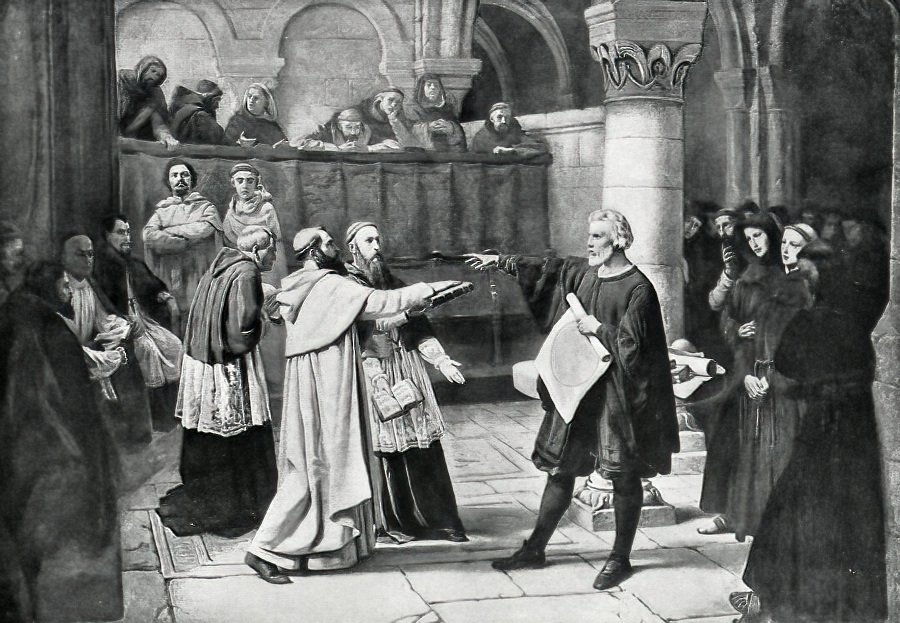
There was no compelling evidence for the heliocentric theory at that time, and the mathematics to make it work were more complicated than for geo-centrism. Kepler’s theory of elliptical orbits fixed this problem, but that still did not amount to anything approaching proof.
Heliocentrism was widely taught. No one had an issue with it as a theory (I do not mean theory in the sense of evolutionary theory or gravity here, but in its common sense as something unproven). Its status as a theory – an unproven possibility – was all that was justified at that time.
Nor did the Church at that time hold to a “literal and immutable” understanding of Scripture. That, in the sense of modern fundamentalism, is a far more recent invention. The Church had always recognised and understood that the Bible includes multiple different forms of literature, and that these need to be interpreted carefully, prayerfully, and in accordance with their history and genre.
1,000 years before Galileo, St Augustine had said that the facts about the world and its origins can be known “with the greatest certainty by reasoning or by experience,” even by non-Christians, and that Christians should avoid contradicting the findings of science when interpreting Genesis. He also said it is “disgraceful and dangerous” for a Christian to talk foolishly about these matters while claiming to explain Holy Scripture.
Cardinal Bellarmine, the Cardinal in charge of the enquiry into Galileo and his fitness to hold a teaching position, wrote in 1615 that if a proven natural truth appeared to make any interpretation of Scripture false, we should be willing to consider that it was our interpretation that was incorrect, and try to do better. In his own words: “No effect of nature established by experience or necessary demonstration should be made doubtful by Scripture passages that admit multiple interpretations.”
Galileo refused to teach anything except his own pet theories. In many of these, he was completely wrong. For example, as Einstein noted in 1953, Galileo’s theories about tidal action were nonsense. Galileo believed the rings of Saturn were not rings but a large moon on either side. He was savage in his attacks on Jesuit astronomer Orazio Grazzi, who correctly described comets as small heavenly bodies, while Galileo insisted they were reflections shining on vapours rising from the earth. In each of these instances, Galileo refused to teach or consider any other possibility.
The disagreement was not primarily about heliocentrism, or about the interpretation of Scripture. It was about Galileo’s persistent refusal to teach anything except his own views. Instead, the Church insisted, on matters which could not absolutely be proven one way or another, that every reasonable possibility should be presented, evidence for each offered and argued, and students permitted to arrive at their own views (which they would then be required to defend) based on the evidence.
This why Feyerabend noted that during that dispute the Church in its argument and attitude was far more reasonable and science-friendly than Galileo. It is an argument and attitude from which many contemporary learning institutions would greatly benefit!



Leave a Reply